
Jewelry businesses often manage large numbers of small, high-value products, each with its own design, material, size, gemstone configuration, and commercial value. Rings, earrings, necklaces, bracelets, watches, and loose accessories may be stored in trays, display cases, drawers, or secure storage areas.
Keeping accurate records of every item can be challenging. Manual barcode scanning requires items to be presented individually, while visual counting can become time-consuming when many similar-looking products are handled throughout the day.
Radio frequency identification (RFID) offers another approach. By assigning an electronic identity to each tagged item, an RFID system can help businesses perform inventory checks, locate discrepancies, and manage stock movement with less dependence on individual line-of-sight scanning.
However, jewelry is a demanding application for RFID. Small tag dimensions, metal components, dense storage arrangements, and aesthetic requirements all influence the choice of tag and reader configuration.
This guide explains how UHF RFID can support jewelry management, what engineering challenges businesses should consider, and how to evaluate jewelry RFID labels before implementation.
1. Why Does Jewelry Inventory Management Present Unique Challenges?
Unlike many packaged retail products, jewelry items are often physically small, visually similar, and individually valuable.
A jewelry retailer may need to manage hundreds or thousands of individual pieces across display counters, back-office storage, repair areas, and sales locations. Even products with the same design may have different sizes, gemstone combinations, serial numbers, or prices.
Several characteristics make inventory control particularly demanding.
| Jewelry inventory challenge | Operational impact |
|---|---|
| Small individual items | Tags must fit without interfering with product presentation or handling |
| High item value | Accurate identification and stock reconciliation are important |
| Similar-looking products | Staff may need to distinguish items with very small visual differences |
| Metal components | Nearby conductive materials can affect UHF antenna performance |
| Dense storage | Multiple tags may be positioned close together, creating a challenging RF environment |
| Frequent handling | Tags and attachment points must remain suitable during normal handling |
| Aesthetic requirements | Labels should not unnecessarily affect the appearance of the jewelry |
Traditional barcode labels remain useful, particularly for point-of-sale operations and products where visual scanning is convenient. RFID can complement these methods by enabling multiple tagged items to be identified through radio communication without requiring each label to be individually presented to a scanner.
The goal is not simply to replace every barcode. It is to create a reliable item-identification process that fits the jewelry business’s existing operations.
2. How Can RFID Support Item-Level Jewelry Management?
Passive UHF RFID systems use a reader and antenna to communicate with RFID tags attached to products. The reader transmits an RF signal, and a passive tag harvests energy from that signal before responding through backscatter communication.
Each tag can carry an identifier, commonly an Electronic Product Code (EPC) in GS1-based deployments. The identifier can be associated with the corresponding jewelry record in an inventory or retail management system.

2.2 Inventory counting
Staff can use a handheld RFID reader to identify multiple tagged items in a defined area, such as a storage tray, stockroom shelf, or jewelry counter.
Depending on tag performance, reader configuration, and item arrangement, the system may capture several identifiers without requiring each item to be individually scanned.
The collected identifiers can then be compared with the inventory database to identify:
- Items detected in the current location
- Expected items that were not detected
- Items recorded in the system but found in another location
- Potential discrepancies requiring manual verification
RFID does not automatically guarantee that every item will be detected. The reading process must be validated for the actual jewelry, tag placement, storage arrangement, and reader setup.
2.3 Stock movement and reconciliation
RFID identification can also support stock movement between different operational areas.
For example:
- Jewelry is received into the store.
- Each item’s RFID identifier is associated with its product record.
- Items are assigned to storage or display locations.
- Staff perform periodic inventory checks.
- Items are transferred between display, storage, repair, and sales areas.
- The system updates the relevant inventory records based on verified business events.
GS1 describes comparable item-level retail RFID workflows involving goods receiving, inventory capture, and store-floor replenishment. The exact workflow for jewelry should be adapted to the retailer’s operations.
3. Why Do Small Tag Dimensions Matter in Jewelry Applications?
Jewelry products often have limited space for an RFID label. A tag designed for a large retail package may be unsuitable for a small ring, pendant, or pair of earrings.
The tag must provide enough space for an effective antenna design while remaining compatible with the product’s dimensions and attachment method.
This creates a design trade-off between physical size and RF performance.
3.1 Antenna size and performance
The antenna is a key component of a passive UHF RFID tag. Its geometry, impedance, efficiency, and relationship with the chip influence how effectively it receives energy and returns a readable signal.
Reducing the antenna dimensions may limit the available design space and make antenna matching more challenging. The result depends on the antenna structure, substrate, chip characteristics, and intended operating environment.
A smaller label is therefore not automatically a better jewelry RFID label.
The engineering objective is to achieve a suitable balance among:
- Overall label dimensions
- Antenna geometry
- Chip and antenna impedance matching
- Required reading performance
- Attachment and handling requirements
- Production consistency
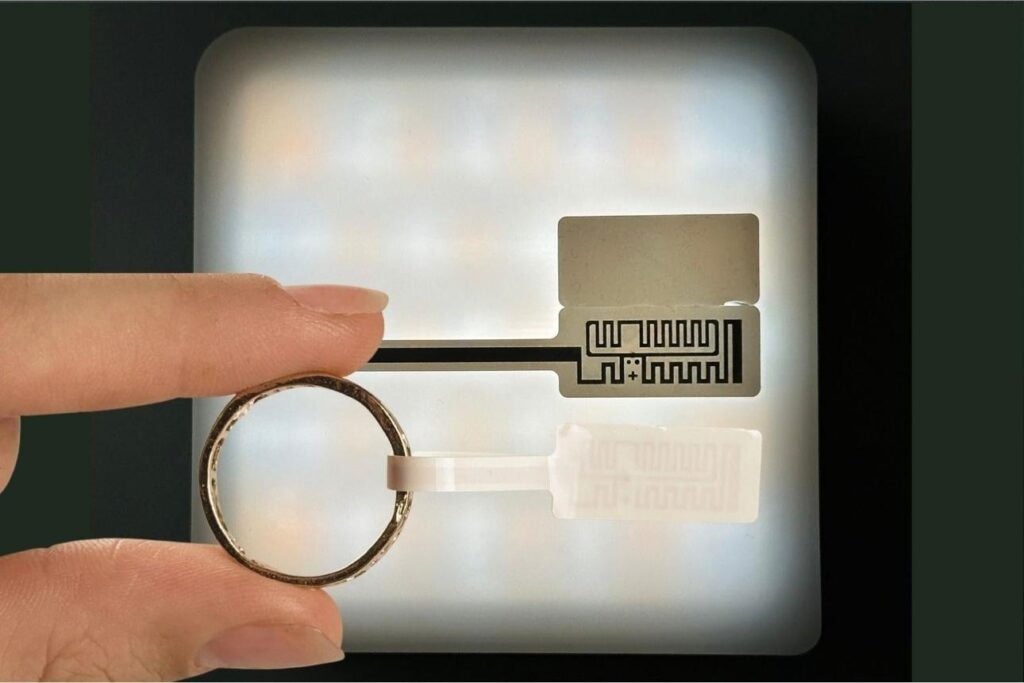
3.2 The importance of the final label construction
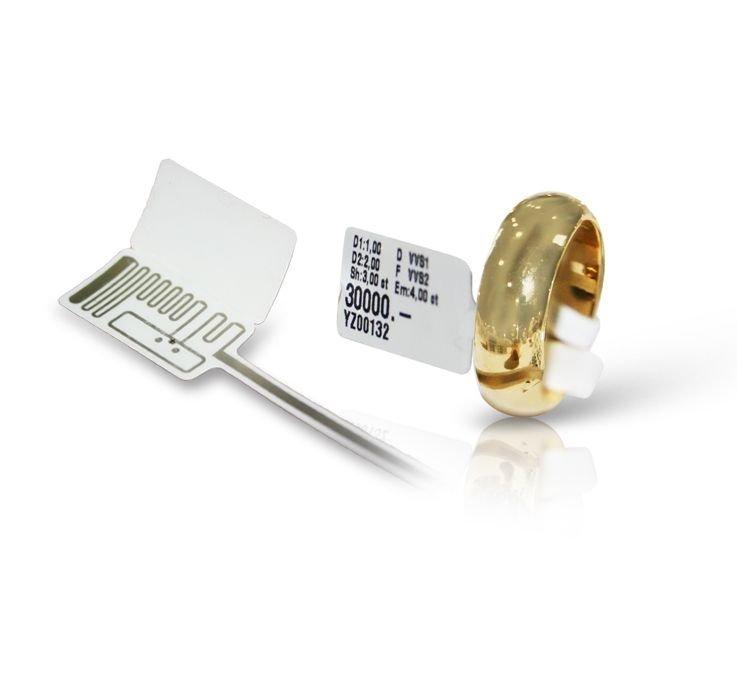
The finished product may include more than an antenna and chip. Depending on the design, it may also include a substrate, protective layer, adhesive, printable surface, or a specific attachment feature.
These materials and layers can influence:
- Overall thickness
- Flexibility
- Mechanical handling
- Adhesion to the intended surface
- Antenna behavior
- Printing and encoding compatibility
For this reason, jewelry businesses should evaluate the complete finished label rather than selecting an inlay based only on its nominal antenna dimensions.
3.3 Small does not mean universally suitable
A tag that works well on a larger necklace tag may not perform equally well on a narrow ring label. Similarly, a label suitable for a bracelet may be inconvenient for a small earring pair.
Different jewelry categories may require different tag dimensions, shapes, and attachment methods.
The correct format should be selected according to the actual item and how the item will be stored, displayed, counted, and handled.
4. How Do Metal Jewelry Components Affect UHF RFID Performance?
Many jewelry products contain conductive metals, including gold, silver, platinum, and various metal alloys. Watches and some accessories may also contain substantial metal components.
Metal can influence the behavior of a UHF RFID antenna. Depending on the tag design and mounting arrangement, nearby conductive surfaces may alter antenna impedance, current distribution, resonance, and radiation behavior.
This can reduce the energy available to activate a conventional tag or weaken its response.
However, the effect is not identical for every jewelry item.
4.1 Jewelry shape and metal arrangement matter
Consider the following examples:
| Jewelry item | Possible RF consideration |
|---|---|
| Gold ring | Small curved metal structure and limited space for label attachment |
| Silver bracelet | Metal links and changing tag orientation during handling |
| Necklace | Chain geometry and possible proximity between the tag and multiple metal components |
| Pendant | Metal backing or decorative structure close to the tag |
| Wristwatch | Compact arrangement of conductive components and limited installation space |
| Gemstone jewelry | Different combinations of metal settings, stones, and tag positions |
These examples illustrate potential design considerations, not guaranteed performance outcomes. A tag may behave differently depending on the exact item geometry and where it is attached.
4.2 Direct contact with metal should be evaluated carefully
A conventional UHF inlay is not automatically suitable for direct attachment to a metal jewelry surface.
Where the tag is placed directly against or very close to metal, a design intended for that mounting condition may be necessary. In other situations, the jewelry item may be tagged through a separate paper or plastic hang tag, with the RFID antenna positioned away from the metal.
These are different installation approaches and should not be treated as interchangeable.
Research into small UHF RFID antennas for metallic objects demonstrates that metal-compatible designs require specific antenna structures and careful engineering. The results of a particular research prototype should not be interpreted as the expected performance of a commercial jewelry label.
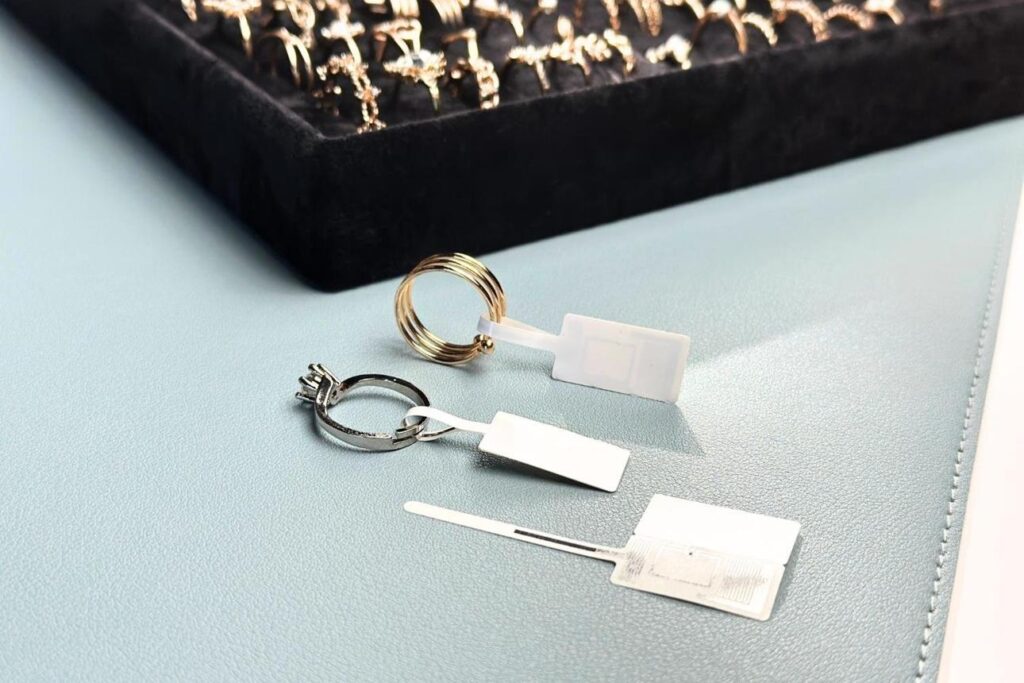
4.3 Test representative jewelry items
When evaluating a jewelry RFID label, do not test only on a flat table or an empty label sample.
Include representative examples of the actual products:
- Different metal types
- Different item sizes and shapes
- Jewelry with different amounts of metal
- Items with different tag attachment positions
- Items stored individually and in groups
This helps reveal whether performance changes with the jewelry design or storage arrangement.
5. What Jewelry RFID Label Structures and Attachment Methods Should Be Considered?
The best label format depends on the jewelry product, available attachment space, visual requirements, and inventory workflow.
There is no single structure that is suitable for every jewelry application.
5.1 UHF jewelry RFID labels
A UHF jewelry label is generally designed for item identification in retail or inventory applications.
Depending on the product construction, the label may be configured as a compact label or a tag suitable for attachment to the jewelry or its packaging.
Important design considerations include:
- Label length and width
- Antenna dimensions
- Chip selection
- Printable area
- Adhesive or attachment structure
- Thickness and flexibility
- Distance between the antenna and the jewelry metal
5.2 Jewelry RFID inlays
The inlay is the functional RFID component that includes the antenna and chip.
For jewelry applications, inlay selection should consider the available physical space, desired label shape, and intended attachment method.
A small inlay may help reduce the overall label footprint, but its suitability must be evaluated in the complete label construction and on the actual jewelry item.
5.3 Customized small-size RFID labels
Customized labels may be considered when standard label dimensions or shapes do not fit the jewelry product or workflow.
Customization may involve reviewing:
- Overall dimensions and shape
- Antenna layout
- Chip option
- Label substrate
- Printable surface
- Attachment method
- Encoding requirements
The final design should be assessed as a complete tag rather than treating any one component as the sole determinant of performance.
5.4 Comparing common attachment approaches
| Attachment approach | Potential application | Important consideration |
|---|---|---|
| Separate jewelry hang tag | Rings, necklaces, bracelets, and other products with a suitable attachment point | Ensure the label does not interfere with presentation or handling |
| Loop-style attachment | Jewelry items where a loop or string can be secured safely | Check attachment security and the tag’s position relative to metal |
| Product or packaging label | Jewelry boxes, pouches, or packaging | Identifies the package unless the association with the jewelry item is maintained |
| Customized compact label | Items with limited space or specific shape requirements | Requires evaluation of antenna performance and finished construction |
A packaging tag is not necessarily equivalent to an item-level jewelry tag. If the jewelry is separated from its packaging, the business must ensure that the RFID identifier remains correctly associated with the individual item.
6. How Should Readers and Inventory Workflows Be Configured?
A suitable jewelry RFID label is only one part of the system. Reader selection, antenna positioning, inventory procedures, and database integration also influence the outcome.
6.1 Handheld RFID readers
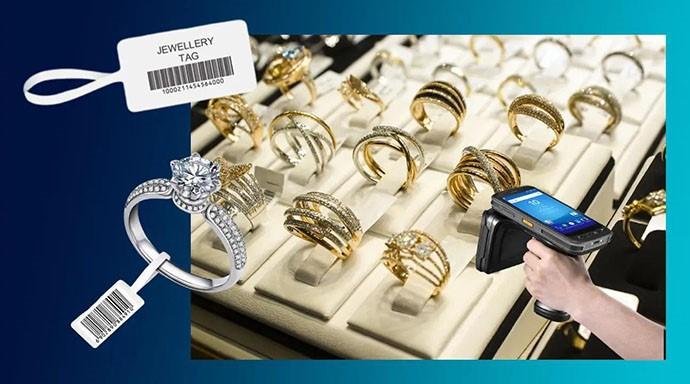
Handheld readers can be used for periodic inventory checks in storage areas, display counters, and other locations where staff move between groups of jewelry.
Their suitability depends on:
- Reader frequency and regional configuration
- Reader antenna characteristics
- Reading power settings
- Tag orientation
- Distance from the jewelry
- Density and arrangement of the items
- The operator’s scanning procedure
For example, a staff member checking a tray of rings may need to move the reader around the tray and change the scanning angle to capture items in different positions.
The reading process should be tested to determine whether the intended workflow can reliably identify the required items.
6.2 Fixed readers and defined read zones
Fixed readers may be useful in locations where jewelry regularly enters or leaves a defined area.
Potential applications include:
- Receiving stations
- Storage cabinets
- Stock transfer points
- Display areas
- Selected inventory-control checkpoints
A fixed-reader setup needs careful antenna positioning. The objective is to read the intended jewelry items while minimizing missed reads and unintended detection of items in nearby areas.
6.3 Inventory workflow design
The technology should be integrated with clear business procedures.
A typical jewelry inventory workflow could include:
1. Assign an item identity
Create the jewelry product record and its unique item identifier.
2. Apply and encode the RFID label
Associate the tag’s EPC or identifier with the correct jewelry item.
3. Verify the tag
Confirm that the identifier can be read and matches the intended item record.
4. Perform inventory checks
Read tagged items in storage, display, or receiving areas.
5. Reconcile inventory records
Compare captured identifiers with expected inventory and investigate discrepancies.
GS1’s EPC/RFID architecture describes how serialized item identifiers can be captured by readers and used in retail inventory systems. The jewelry business should define its own data and event-management rules to fit its stock processes.
6.4 Encoding and item identification requirements
Before ordering jewelry RFID labels, businesses should define how the identifier will be generated and managed.
Questions to resolve include:
- Does each individual jewelry item require a unique EPC?
- Will the EPC follow a GS1 identification scheme or an internal numbering system?
- How will the EPC map to the existing SKU and serial-number records?
- Will any additional data be written to the tag’s User memory?
- Who is responsible for encoding and verifying the labels?
- How will duplicate or incorrectly associated identifiers be detected?
GS1 explains that EPC supports serialized identification and provides standardized encoding approaches. A consistent identification plan helps prevent conflicts between different data systems.
7. How Should Jewelry RFID Labels Be Evaluated Before Deployment?
A label should be evaluated using representative jewelry and the intended inventory process. Testing only an isolated label does not establish whether the complete application will work reliably.
Step 1: Define the jewelry categories
Select representative items such as rings, necklaces, bracelets, pendants, and watches.
Record their materials, dimensions, shapes, and available attachment locations.
Step 2: Confirm label size and attachment
Check whether the proposed label can be attached securely without obstructing product presentation, interfering with normal handling, or changing the intended tag position.
Step 3: Test on actual jewelry
Attach the label using the proposed method and test it on the actual product.
Include products with different metal structures and different tag orientations. Do not assume that a result from one ring or necklace applies to every item in the category.
Step 4: Test the real storage arrangement
Test jewelry individually and in its expected storage configuration, such as:
- Jewelry trays
- Display cases
- Storage drawers
- Boxes and pouches
- Multiple items arranged close together
The physical arrangement can influence RF propagation and the reader’s ability to identify the tags.
Step 5: Verify reading consistency
Record the number of attempts and successful reads under defined conditions. Check for missed items, inconsistent reads, and unintended detection of items outside the intended inventory area.
Step 6: Verify encoding and data association
Confirm that each physical jewelry item is associated with the correct RFID identifier and database record.
A technically readable tag is not sufficient if its identifier is linked to the wrong product.
Step 7: Conduct an operational trial
Use the proposed label, reader, and software workflow in a representative inventory process.
Evaluate whether staff can complete receiving, counting, locating, transferring, and reconciliation tasks using the system as intended.
8. Common Mistakes When Implementing RFID for Jewelry
| Common mistake | Why it causes problems | Better approach |
|---|---|---|
| Choosing a label only by its advertised size | A compact label may not meet the application’s reading requirements | Evaluate dimensions and RF performance together |
| Assuming one tag works for every jewelry category | Different shapes, materials, and attachment positions can produce different results | Test representative products from each category |
| Ignoring metal proximity | Conductive jewelry components may affect antenna behavior | Test the tag in its final position on the jewelry |
| Testing only a single item | Dense storage and multiple nearby tags can change reading behavior | Test trays, drawers, and display arrangements |
| Ignoring tag attachment | A poorly positioned label may become inconvenient or affect performance | Validate the complete attachment method |
| Treating packaging identification as item identification | The jewelry may become separated from the package | Maintain a reliable item-to-tag association |
| Failing to verify encoding | A readable EPC may still be linked to the wrong product | Check every tag against the intended item record |
| Assuming RFID eliminates inventory errors | Missed reads, duplicate records, and workflow issues can still occur | Establish repeatable inventory and reconciliation procedures |
9. Choosing the Right RFID Label for Jewelry Management
RFID can support jewelry businesses by enabling item-level identification, inventory counting, stock reconciliation, and more structured product movement records.
However, jewelry presents specific engineering challenges. Small tag dimensions, metal components, attachment limitations, dense storage arrangements, and aesthetic requirements all influence the suitability of a UHF RFID label.
A successful solution therefore requires more than choosing the smallest available tag or the product with the longest advertised reading distance.
Businesses should evaluate the complete tag construction, test it on representative jewelry, confirm the attachment method, configure readers for the actual storage environment, and verify that each RFID identifier is correctly associated with its item record.
HIVE RFID provides UHF RFID inlays, labels, and tags, including options for customized small-size label development. For jewelry applications, the appropriate starting point is a review of the product dimensions, jewelry material, attachment requirements, reader configuration, and intended inventory workflow.
Need a customized UHF RFID label for jewelry inventory management? Share your jewelry type, required label dimensions, attachment method, metal content, reading requirements, printing and encoding needs, and estimated quantity. These details will help establish a suitable direction for product evaluation and customization.


