
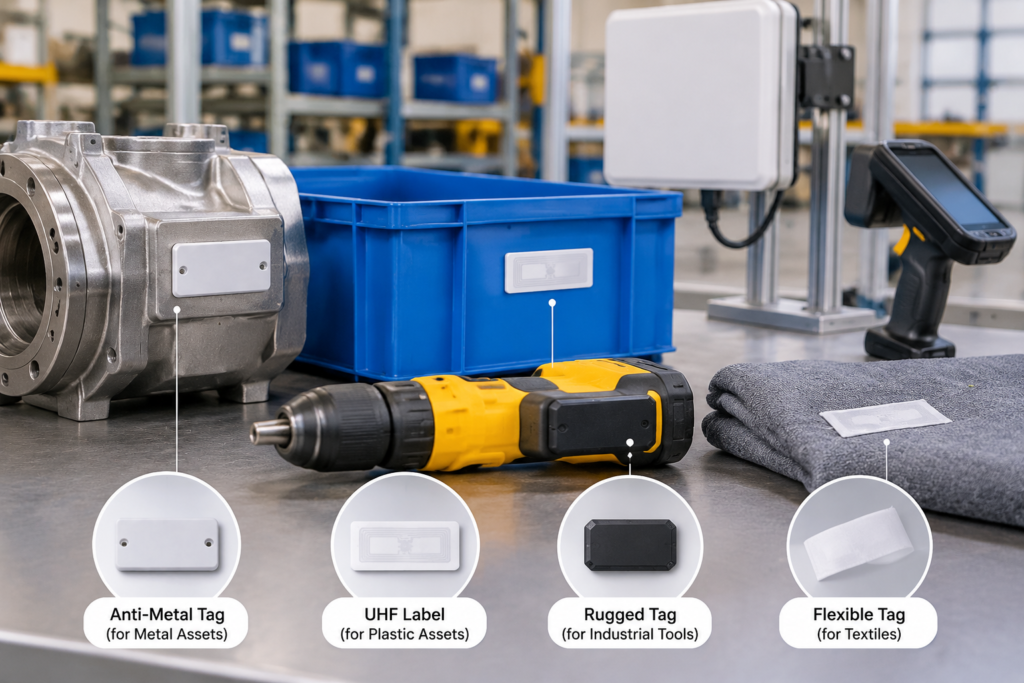
Industrial companies manage a wide range of physical assets, including machinery, tools, production fixtures, reusable containers, spare parts and metal equipment. Keeping track of these assets is essential for inventory control, maintenance management, production efficiency and operational visibility.
Traditional asset identification methods, such as printed labels and barcodes, can work well in many situations. However, they often require individual scanning and a clear line of sight. UHF RFID technology provides another approach by allowing tagged assets to be identified wirelessly, sometimes without direct visual contact.
However, choosing an RFID tag for industrial asset tracking is not simply a matter of selecting a tag with a particular chip or reading distance.
A tag that works well on a plastic container may perform poorly when attached directly to a metal machine. A compact tag may fit a small tool but may not provide the required reading performance. A tag that works in a laboratory may also behave differently when installed in a factory surrounded by metal structures, electrical equipment and other potential sources of RF interference.
These challenges make tag selection an important part of industrial RFID system design.
So, how do you choose the right UHF RFID tag for industrial asset tracking?
The answer depends on several factors: the asset material, mounting position, reading requirements, physical dimensions, operating environment, tag construction and reader configuration.
This guide explains these factors and provides a practical selection process for industrial buyers and RFID system integrators.
1. Understand What You Need to Track

Before selecting an RFID tag, start by identifying the assets that need to be tracked.
Industrial asset tracking covers many different objects, and their physical characteristics can vary considerably.
For example:
| Asset type | Typical characteristics | Important tag considerations |
|---|---|---|
| Industrial machinery | Large metal surfaces, fixed installation | Anti-metal design, mounting position |
| Hand tools | Compact, frequently handled | Small dimensions, attachment security |
| Plastic containers | Non-metallic, reusable | Adhesion, abrasion resistance |
| Metal racks and carts | Large metal structures | On-metal compatibility, reading direction |
| Production fixtures | Metal or composite construction | Mounting method, temperature exposure |
| Textile assets | Flexible, frequently handled | Flexible construction, attachment method |
| Returnable transport items | Repeated circulation and handling | Durability, consistent identification |
The first step is to understand how each asset is used throughout its lifecycle.
Consider the following questions:
- What type of asset needs to be identified?
- What material is it made from?
- Is the asset stationary or frequently moved?
- Does it have a flat, curved or irregular surface?
- Will it experience impact, vibration or abrasion?
- Where will the RFID reader identify the asset?
For example, tracking a stationary metal machine requires a different tag evaluation from tracking plastic containers moving through a warehouse.
Practical tip: Take photographs of representative assets and mark the proposed tag installation locations. If possible, provide the approximate dimensions of the available mounting area.
This information gives the manufacturer a much better starting point for evaluating suitable tag designs.
2. Consider the Material of the Asset
The material surrounding an RFID tag can significantly affect its RF performance.
This is particularly important for passive UHF RFID tags, which receive energy from a reader and communicate by backscattering the received RF signal.
Different materials interact with electromagnetic waves in different ways.
Non-metallic surfaces
Standard UHF RFID labels are commonly designed for applications involving suitable non-metallic surfaces, such as:
- Cardboard
- Paper
- Plastic
- Wood
- Other suitable materials
These surfaces are often less challenging for conventional UHF label designs.
However, not every standard UHF label performs equally well on every non-metallic object. The asset’s geometry, contents, tag position and surrounding materials can still affect performance.
Metal surfaces
Metal is one of the most important considerations in industrial RFID applications.
When a conventional UHF RFID label is attached directly to metal, the metal interacts with the tag antenna’s electromagnetic field. This can change the antenna’s electrical characteristics and cause problems such as detuning and impedance mismatch.
The result may be reduced tag sensitivity, weaker communication or inconsistent reading performance.
For this reason, metal equipment often requires a dedicated anti-metal RFID tag, also known as an on-metal RFID tag.
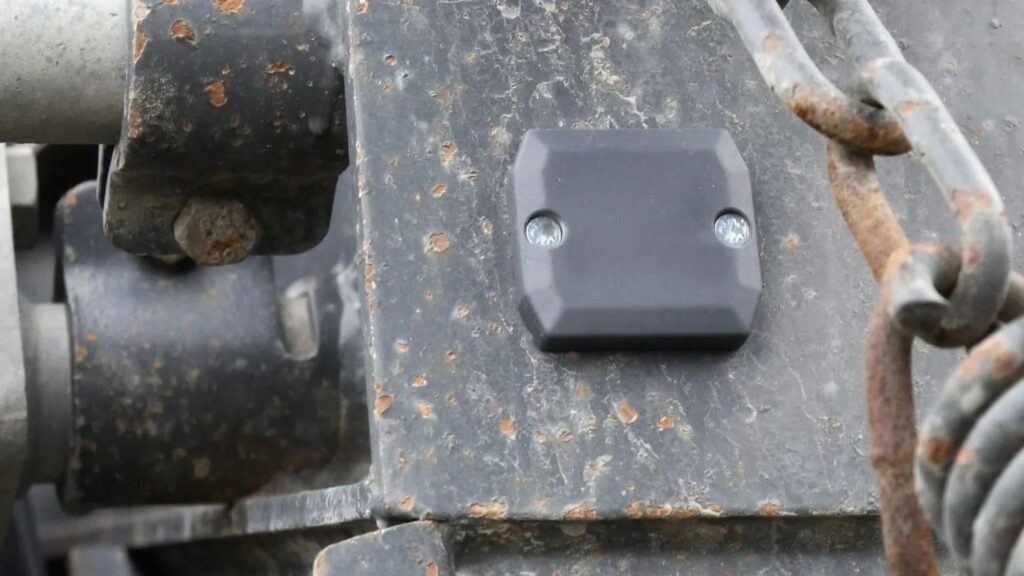
Anti-metal RFID tags are designed for operation under specified metal-mounting conditions. Depending on the design, they may incorporate dedicated antenna structures, spacing or other construction features to support operation on metal.
A conventional RFID label should not be assumed to work properly simply because it can physically adhere to a metal surface.
Liquid-containing and wet assets
Liquid-containing products also require attention.
Water and other liquids can absorb RF energy and affect the performance of nearby RFID antennas. A tag that works well on an empty plastic container may behave differently when the container is filled.
The actual effect depends on the liquid, container geometry, tag design and installation position.
Material-based tag selection
| Asset material | Initial tag consideration | Important validation |
|---|---|---|
| Cardboard | Standard UHF RFID label | Label position and orientation |
| Plastic | Standard UHF label or suitable hard tag | Material, geometry and contents |
| Metal | Dedicated anti-metal RFID tag | Metal surface and mounting position |
| Liquid-containing container | Application-specific design | Liquid level and tag location |
| Fabric or textile | Flexible or textile-oriented tag | Attachment and care conditions |
| Glass | Application-specific design | Glass type and surrounding materials |
This table provides an initial selection direction, not a universal compatibility guarantee. Testing on the actual asset remains important.
3. Define the Reading Distance and Reading Method

A tag should be selected according to how the RFID system will identify the asset.
Different reading methods create different technical requirements.
Handheld inventory
In handheld inventory applications, employees use mobile RFID readers to scan assets in warehouses, factories or maintenance areas.
Important considerations include:
- Convenient scanning distance
- Tag accessibility
- Tag orientation
- Asset density
- Ease of identifying individual items
The system may not require the maximum possible reading distance. A predictable reading area and reliable identification may be more important.
Fixed-reader identification
Fixed readers and antennas may be installed at workstations, storage locations, equipment entrances or production areas.
In these applications, the tag must be positioned so that it can be identified within the intended reading area.
The system should also avoid reading unrelated assets outside that area.
Portal and passage-point reading
When assets pass through a gate or designated checkpoint, the system may need to identify multiple tags within a limited time.
Relevant factors include:
- Asset movement speed
- Reading-zone dimensions
- Reader antenna placement
- Tag orientation
- Number of assets passing simultaneously
- Nearby metal structures
Conveyor and production-line reading
On a conveyor, the tag may move past the reader at a relatively consistent speed and direction.
The system needs to identify the tag during the available reading window.
Therefore, the appropriate tag is not necessarily the one with the longest advertised reading distance. Its performance within the actual conveyor reading zone matters more.
Maximum read distance is not everything
UHF RFID read range depends on several factors, including reader output power, reader antenna gain and polarization, RF interference, tag orientation and the surrounding environment.
It is useful to distinguish between four different performance considerations:
| Performance factor | Meaning |
|---|---|
| Maximum read distance | Greatest distance achieved under specified test conditions |
| Read-zone coverage | Area or volume where tags can be identified |
| Read consistency | How reliably tags are identified over repeated attempts |
| Unwanted reads | Identification of assets outside the intended reading zone |
For industrial applications, the shape and reliability of the reading zone may be more important than the maximum distance achieved in an isolated test.
Instead of simply asking for a long-range tag, describe the actual reading scenario.
For example:
We need to identify metal tools stored on industrial racks using handheld UHF RFID readers. The tags will be attached to the tool housings, and operators need to scan the assets from different angles during periodic inventory checks.
This gives the manufacturer much more useful information for evaluating suitable tag options.
4. Select the Appropriate RFID Tag Construction
Industrial assets differ in size, shape and operating conditions. RFID tags are therefore available in different physical constructions.
The appropriate construction depends on the mounting surface, available installation space, attachment method and environmental exposure.
Standard UHF RFID labels
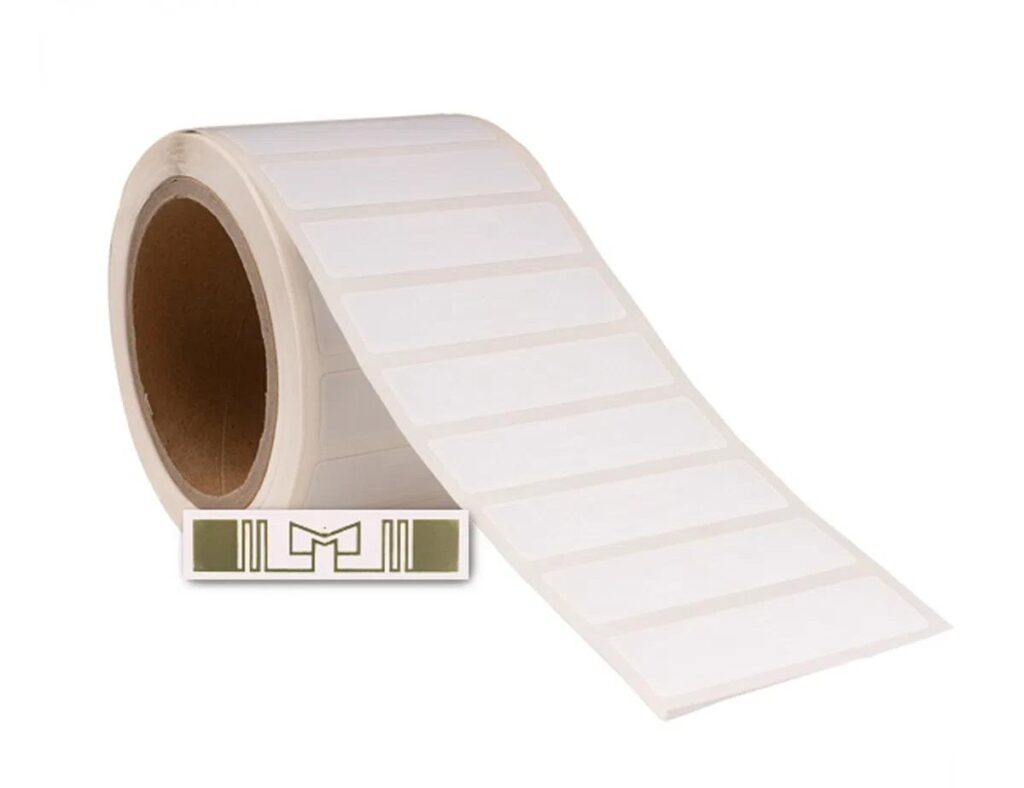
Standard UHF RFID labels are commonly used on suitable non-metallic surfaces.
Potential applications include:
- Plastic storage containers
- Cardboard packaging
- Non-metallic components
- Warehouse inventory labels
Their relatively thin construction makes them convenient for applications where space and weight are important.
However, conventional UHF labels should not automatically be selected for direct metal mounting.
Anti-metal RFID tags
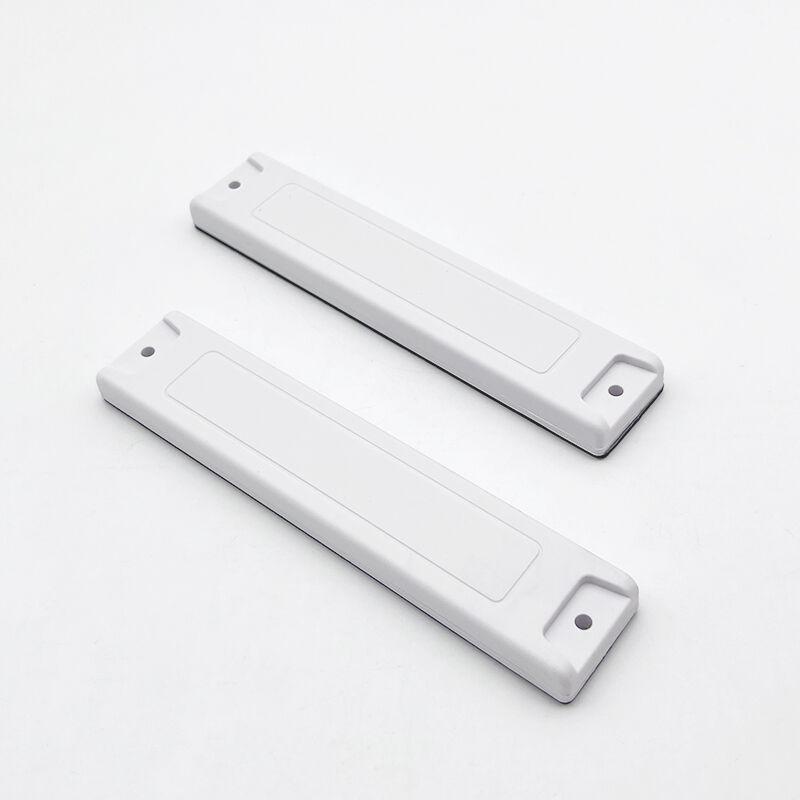
Anti-metal RFID tags are designed for applications where the tag is mounted on metal surfaces.
They may be used for:
- Industrial machinery
- Metal tools
- Equipment cabinets
- Metal containers
- Industrial racks and fixtures
Different anti-metal RFID tags use different structures and materials.
For example, PCB-style and ABS-enclosed designs can have different physical characteristics and installation requirements.
The appropriate choice depends on the available space, mounting method and actual operating conditions.
Flexible RFID tags
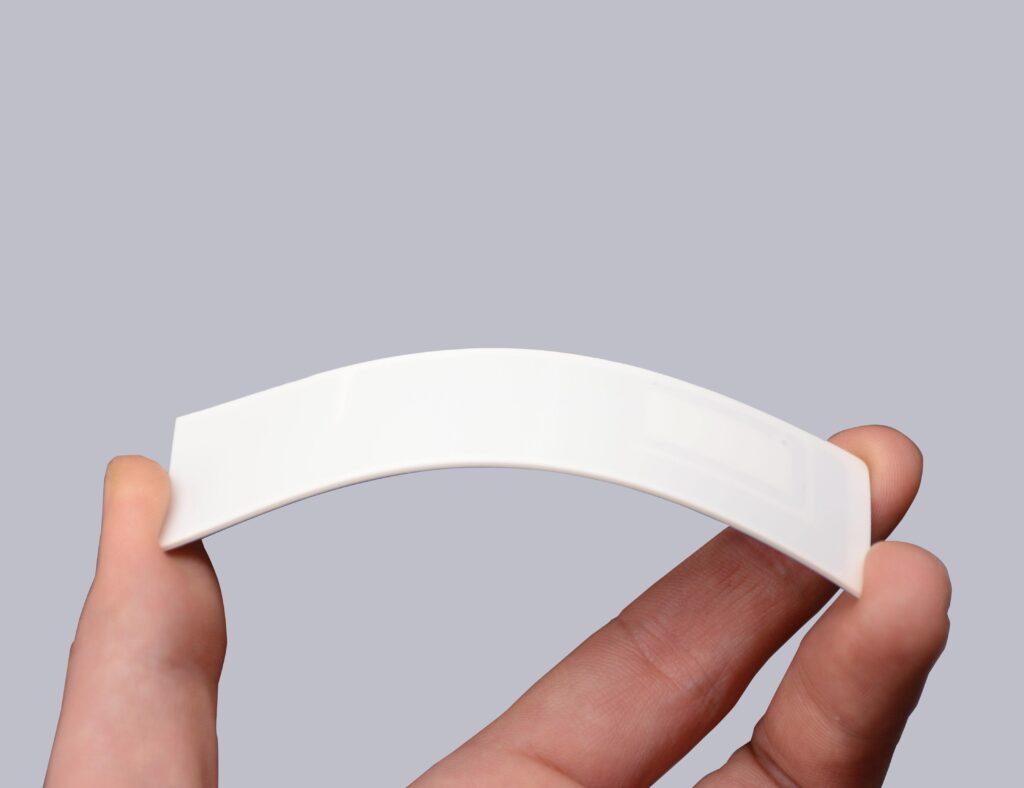
Flexible RFID tags may be considered when the installation surface is curved or when a rigid tag is inconvenient.
Potential applications include:
- Selected curved equipment surfaces
- Space-constrained installations
- Applications requiring a more adaptable physical structure
However, flexibility does not automatically mean that a tag can withstand repeated bending, twisting or mechanical stress.
The permissible bending conditions and durability should be confirmed for the specific product.
Rugged hard tags
Rugged hard tags are used when the application requires a more protected physical structure.
Depending on the design, they may be attached using adhesive, screws, rivets or other mechanical methods.
They can be considered for frequently handled tools, reusable containers and industrial equipment.
Protection against impact, water, chemicals and temperature must be verified from the actual product specifications. A hard enclosure alone does not establish a particular protection rating.
Tag construction comparison
| Tag construction | Typical application | Main consideration |
|---|---|---|
| Standard UHF label | Suitable plastic, paper and cardboard assets | Surface compatibility and label size |
| Anti-metal tag | Metal machinery, tools and equipment | Metal compatibility and mounting space |
| PCB-style anti-metal tag | Selected industrial applications | Structure and mechanical installation |
| ABS anti-metal tag | Applications requiring an enclosed structure | Dimensions and attachment method |
| Flexible RFID tag | Selected curved or space-constrained surfaces | Flexibility limits and mounting conditions |
| Rugged hard tag | Reusable and frequently handled assets | Physical protection and attachment security |
These categories are not mutually exclusive. For example, an anti-metal RFID tag may also have a flexible or enclosed construction.
The correct selection should be based on the actual product design and its intended application.
5. Evaluate Environmental and Mechanical Requirements
Industrial assets often operate in environments that are more demanding than ordinary retail or office applications.
A tag may be exposed to temperature changes, vibration, chemicals, cleaning procedures, dust, moisture or mechanical impact.
The tag must remain physically attached and maintain the required identification performance throughout its intended service conditions.
Temperature
Consider both operating temperature and storage conditions.
If an asset is exposed to high temperatures during manufacturing, welding or other industrial processes, clarify whether the RFID tag will be installed before or after that process.
Do not assume that storage temperature, continuous operating temperature and short-term temperature exposure are interchangeable.
Moisture and water
For outdoor or wet environments, clarify whether the tag will experience:
- Occasional splashing
- Rain exposure
- Frequent washing
- Temporary immersion
- Continuous moisture exposure
A general description such as “waterproof” is not enough to define the actual requirement.
Chemicals
Industrial assets may come into contact with oils, lubricants, detergents, solvents and cleaning agents.
The tag’s outer material, adhesive and antenna construction should be evaluated against the actual chemicals and exposure conditions.
Mechanical stress
Consider whether the tag will experience:
- Impact from tools or equipment
- Vibration during operation
- Repeated handling
- Abrasion against other objects
- Bending or deformation
- Attachment damage
Environmental requirement checklist
| Factor | Information to provide |
|---|---|
| Temperature | Expected operating and storage conditions |
| Moisture | Indoor, outdoor, wet or washing exposure |
| Chemicals | Chemical type and exposure frequency |
| Mechanical stress | Impact, vibration, abrasion or bending |
| Service life | Expected duration of use |
| Cleaning process | Manual cleaning, industrial washing or other procedures |
| Installation | Permanent or removable mounting |
For demanding applications, the complete tag-and-asset assembly should be evaluated rather than testing the tag alone.
6. Check Tag Dimensions and Available Installation Space
Tag size is another important selection factor.
A larger antenna may provide advantages in RF performance, but industrial assets often have limited mounting space.
For example:
- A compact tool may only have a small flat area.
- A machine component may have a curved or recessed mounting position.
- A reusable container may provide a larger label area.
- A metal fixture may require enough space for a dedicated anti-metal tag.
This creates a practical trade-off between physical dimensions and RF requirements.
Before selecting a tag, measure:
- Maximum available length and width.
- Maximum allowable thickness.
- Whether the mounting surface is flat or curved.
- Whether the tag can extend beyond the asset surface.
- Whether the tag may interfere with the asset’s operation.
- Whether the installation position is accessible for maintenance.
Do not assume that a smaller tag will provide the same reading performance as a larger one.
Antenna design, operating frequency, mounting surface and tag orientation all influence the final result.
If the available space is limited, share a photograph and dimensioned drawing with the manufacturer.
7. Consider Chip and Data Requirements
The RFID chip stores identification data and supports communication with the reader.
In many passive UHF industrial asset-tracking applications, the primary purpose of the tag is to provide a unique identifier associated with an asset record in the customer’s management system.
Before selecting a chip, clarify the application’s data requirements.
Important questions include:
- Does the project require a specific chip model?
- Is EPC memory sufficient?
- Is additional User memory required?
- Does every asset need a unique identifier?
- Will tags be encoded before installation?
- Are password protection or other chip functions required?
- Does the project follow an existing enterprise or GS1 identification structure?
EPC identification and User memory
For many industrial applications, the EPC is used as the primary identifier.
The reader captures the tag’s identifier, and the asset management system links it to information such as:
- Asset number
- Equipment description
- Department or location
- Maintenance history
- Ownership
- Inspection records
Additional data may be stored in User memory when supported by the chip, but this is not always necessary.
In many systems, keeping detailed asset information in the backend and using the RFID tag primarily as an identifier can simplify tag selection and data management.
Selection tip: Do not choose a chip simply because it has more memory. Start with the data that the system actually needs to store and retrieve.
8. Match the Tag with the RFID Reader System
An RFID tag does not operate independently. It is part of a complete system that includes the reader, reader antenna, software and physical environment.
Even a technically suitable tag may not achieve the intended result if the reader configuration is not appropriate.
| System component | What to evaluate |
|---|---|
| Reader | Supported frequency range and RFID protocol |
| Reader antenna | Antenna type, gain, polarization and mounting position |
| Tag antenna | Orientation and compatibility with the reading setup |
| Reader power | Configured output power and regional restrictions |
| Read zone | Required coverage and unwanted-read control |
| Software | Asset identification and data association |
| Installation | Reader and tag positions relative to surrounding objects |
Linear and circular polarization
Reader antenna polarization can influence the reliability of tag identification.
A linear antenna may be suitable when tag orientation is predictable and controlled.
A circularly polarized antenna may be useful when tag orientation varies.
However, circular polarization does not eliminate every orientation-related problem.
For example:
- A fixed tag on a conveyor may have a predictable orientation.
- A handheld inventory operation may involve tags facing different directions.
- Assets stacked on racks may have inconsistent tag positions.
The tag and reader antenna should therefore be evaluated together.
9. Test Candidate Tags Before Full Deployment

Testing candidate tags under realistic conditions is one of the most important steps in industrial RFID selection.
A tag that reads well on a laboratory table may behave differently after being installed on an actual asset.
For this reason, the evaluation should use the intended mounting surface, reader equipment and reading process whenever possible.
Step 1: Prepare representative assets
Select actual assets or representative samples.
Include different materials, sizes, surface geometries and installation locations if the project involves multiple asset types.
Step 2: Install candidate tags
Attach each candidate tag using the intended installation method.
For example:
- Apply adhesive tags to the planned location.
- Mount anti-metal tags directly on the intended metal surface.
- Use the proposed screws, brackets or mechanical fixing method where applicable.
Do not evaluate a tag only in free air if the final application requires mounting it on a specific material.
Step 3: Use the intended reader configuration
Where possible, use the actual reader and antenna planned for deployment.
Keep important test conditions consistent:
- Reader model
- Antenna model and position
- Frequency configuration
- Reader power
- Reading distance
- Tag orientation
- Asset position
This makes comparisons between candidate tags more meaningful.
Step 4: Test different positions and orientations
Try different installation positions and tag orientations.
A small change in position can affect the RF environment, especially around large metal structures.
If the asset moves during operation, test the tag in the relevant positions and movement conditions.
Step 5: Evaluate read consistency
Do not rely on one successful read.
Repeat the test under representative operating conditions and record:
- Whether the tag is identified
- Whether identification is consistent
- Whether the intended reading zone is covered
- Whether unrelated assets are also read
- Whether performance changes with asset orientation
- Whether the tag remains physically attached
Step 6: Confirm environmental suitability
If the application involves washing, chemicals, vibration or temperature exposure, define the relevant evaluation procedures.
The tests should reflect the actual project requirements.
Passing an RF reading test does not automatically confirm mechanical or environmental durability.
Step 7: Document the approved configuration
Once a suitable candidate has been identified, record:
- Tag model and construction
- Mounting method
- Installation location
- Reader and antenna configuration
- Relevant reading conditions
- Test results
- Acceptance criteria
This provides a useful reference for future purchasing and production batches.
Suggested sample evaluation table
| Test item | What to check | Result |
|---|---|---|
| Surface compatibility | Tag works on the actual asset material | Pass / Fail |
| Reading distance | Meets the project target under defined conditions | Pass / Fail |
| Orientation | Performs acceptably in expected positions | Pass / Fail |
| Read consistency | Repeated identification is sufficiently reliable | Pass / Fail |
| Mounting | Tag remains securely attached | Pass / Fail |
| Environment | Meets defined operating conditions | Pass / Fail |
| System integration | Works with the intended reader and software | Pass / Fail |
Acceptance criteria should be defined by the project team. There is no universal read-distance or read-rate threshold that applies to every industrial asset-tracking system.
10. Common Mistakes When Selecting Industrial RFID Tags
| Common mistake | Why it causes problems | Better approach |
|---|---|---|
| Selecting by maximum read range alone | The actual read zone may not match the application | Evaluate read-zone coverage and consistency |
| Using standard labels on metal | Metal can detune conventional tag antennas | Evaluate dedicated anti-metal designs |
| Ignoring the asset material | Different materials interact differently with RF signals | Identify the actual mounting surface |
| Choosing the smallest possible tag | Reduced antenna space may limit performance | Balance size and RF requirements |
| Ignoring tag orientation | Direction-sensitive tags may become difficult to read | Test realistic orientations |
| Overlooking environmental conditions | Materials or attachment methods may not withstand the application | Define operating conditions |
| Testing only on a laboratory table | Results may not represent actual installation conditions | Test on real or representative assets |
| Ignoring reader antenna selection | Tag and reader work as one RF system | Evaluate both together |
| Failing to document approved samples | Later production may be compared against unclear requirements | Record the approved configuration and test criteria |
11. How HIVE RFID Supports Industrial Asset Tracking Projects
HIVE RFID provides RFID products and customized tag solutions for global B2B customers.
For industrial asset-tracking applications, the selection process should begin with the physical asset and its operating conditions rather than with a predetermined tag model.
Depending on the application, HIVE RFID can discuss suitable options from its RFID tag range, including:
- UHF RFID tags and labels
- PCB anti-metal RFID tags
- ABS anti-metal RFID tags
- Flexible anti-metal RFID tags
- Other application-specific customized tag options
Different tag constructions are intended for different installation conditions. The appropriate solution should be evaluated against the customer’s actual requirements.
When discussing an industrial asset-tracking project with HIVE RFID, it is useful to provide:
- Photos of the assets to be tracked.
- The material and approximate dimensions of each asset.
- The proposed tag installation position.
- The required reading method and target distance.
- The reader model, if already selected.
- Environmental and mechanical requirements.
- Estimated sample and production quantities.
If you do not yet have a finalized tag specification, the application details can serve as the starting point for technical discussion.
The objective is to identify a suitable tag construction for the real application, then validate it through sample testing before proceeding to larger-scale production.
Conclusion
Choosing the right UHF RFID tag for industrial asset tracking requires more than comparing chip models, dimensions or advertised read ranges.
The asset’s material, mounting position, reading scenario, operating environment and reader configuration all influence the final selection.
A practical process begins by identifying what needs to be tracked, defining where and how it will be read, selecting an appropriate tag construction and testing the complete assembly under realistic conditions.
For industrial buyers and RFID system integrators, this application-first approach can reduce unsuitable tag selections and make the evaluation process more systematic.
Looking for a suitable RFID tag for industrial asset tracking?
Share your asset photos, mounting surface, reading requirements and operating conditions with HIVE RFID. These details can help establish the technical direction for a customized RFID tag solution.
G. FAQ
1. What is the best UHF RFID tag for industrial asset tracking?
There is no single best tag for every industrial asset. The appropriate choice depends on asset material, mounting position, required reading scenario, environmental conditions and reader configuration. Metal assets often require dedicated anti-metal tag designs.
2. Can standard UHF RFID labels be used on metal equipment?
A conventional UHF RFID label may experience detuning and reduced performance when attached directly to metal. For direct metal mounting, a tag specifically designed for on-metal applications should be evaluated.
3. What is the typical reading distance of an industrial UHF RFID tag?
There is no universal reading distance. Performance depends on tag design, reader power, reader antenna, tag orientation, mounting surface and the surrounding RF environment. The actual tagged asset should be tested with the intended reader setup.
4. Are smaller RFID tags always better for industrial applications?
No. Smaller tags may be easier to install in limited spaces, but the reduced antenna area can affect RF performance. Physical size should be balanced against the application’s reading requirements.
5. Should I choose a PCB, ABS or flexible anti-metal RFID tag?
The choice depends on the required physical structure, available installation space, mounting method, asset geometry and operating conditions. These constructions should be compared using the actual application rather than assumed to have a fixed performance ranking.
6. How should industrial RFID tags be tested before deployment?
Test candidate tags on representative assets using the intended reader and antenna. Evaluate reading consistency, tag orientation, installation position, attachment security and environmental requirements. Record the approved configuration and acceptance criteria before larger-scale deployment.


