
Why can an ordinary UHF RFID label work perfectly on a cardboard box but become difficult to read when attached to a metal tool, machine or container?
The problem is not necessarily the RFID chip or reader. In many cases, the metal surface changes the electromagnetic environment in which the tag antenna is expected to operate.
This is a common challenge in industrial asset tracking. Metal equipment, machinery, storage racks, containers and tools all need reliable identification, but conventional RFID labels are not automatically suitable for direct metal mounting.
The solution is to select an RFID tag designed for the intended mounting surface. This article explains why metal affects ordinary RFID tags, how anti-metal RFID technology addresses the problem, and what engineers and buyers should consider when selecting a suitable design.
1. Why Does Metal Affect Ordinary RFID Tags?
A passive UHF RFID tag typically consists of two essential components: an integrated circuit (IC), which stores and processes identification data, and an antenna, which receives energy from the reader and communicates the tag’s information through backscatter.
When a reader transmits an RF signal, the tag antenna captures part of that energy. The energy activates the chip, allowing it to respond by modulating the antenna’s reflection of the incoming signal.
This process depends on the antenna operating under suitable electromagnetic conditions.
A conventional UHF RFID label is generally designed and tuned for a particular frequency range and an intended installation environment. When it is attached directly to a conductive metal surface, that environment changes significantly.
1.1 Metal changes the antenna’s electromagnetic behavior
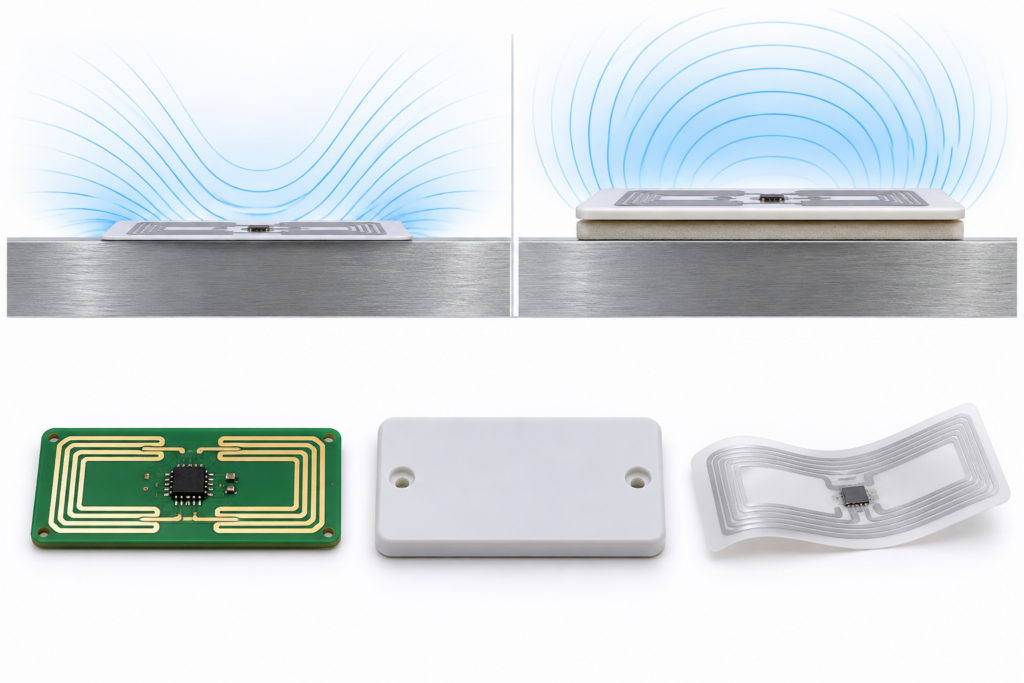
Metal is electrically conductive. When an RFID antenna is placed very close to a conductive surface, the surface can interact with the antenna’s electromagnetic fields and induced currents.
For a conventional dipole-style tag antenna, this interaction can change the antenna’s current distribution and input impedance. It may also shift its resonant behavior and alter its radiation pattern.
The result is a mismatch between the antenna and the RFID chip.
The antenna may then become less effective at transferring received RF energy to the chip. The tag may also produce a weaker backscatter response, making it more difficult for the reader to identify.
This is commonly described as antenna detuning.
1.2 Metal can also change the RF environment around the tag
The effect is not limited to the antenna itself.
Large metal surfaces can reflect radio-frequency signals. These reflections may combine with the direct signal and create multipath propagation, including localized areas where signals partially cancel.
Consequently, a tag can experience poor readability even when the reader is transmitting sufficient power.
This is particularly important in industrial environments where metal machinery, racks, containers and other structures are close to the RFID reading zone.
The key point: Metal does not simply block every RFID signal. It changes the electromagnetic conditions around the tag and can make the antenna-and-chip system operate inefficiently.
2. What Happens When a Conventional RFID Label Is Attached to Metal?
Consider a standard UHF RFID label designed for attachment to cardboard or plastic.
Its antenna is engineered around a particular combination of chip impedance, antenna geometry, substrate and operating frequency. When the label is mounted on a metal surface, the antenna no longer operates in the environment for which it was designed.
Several problems may occur:
| Technical effect | What happens | Possible result |
|---|---|---|
| Antenna detuning | The nearby conductive surface changes the antenna’s electrical characteristics | Reduced energy transfer to the chip |
| Impedance mismatch | The antenna-chip matching condition changes | Less effective RF energy collection |
| Changed radiation pattern | The antenna’s electromagnetic field distribution changes | Reading becomes more orientation-sensitive |
| Weaker backscatter | The tag returns a less detectable response under the new conditions | Unstable or failed identification |
| Multipath reflections | Large metal structures reflect RF signals | Localized reading gaps or inconsistent results |
These effects can occur together. The severity depends on the tag design, frequency, metal geometry, installation conditions and reader configuration.
2.1 Why does the same tag work on plastic but fail on steel?
Plastic is generally much less electrically conductive than metal. A conventional RFID antenna can therefore operate closer to its intended design conditions when mounted on many plastic surfaces.
Steel and aluminum, by contrast, are conductive materials. Their proximity to the antenna can substantially change its electromagnetic behavior.
This explains why a label that performs well on a plastic storage bin may become unreliable when attached directly to a steel tool cabinet.
It is not enough to confirm that a tag works in free space or on a non-metallic test surface. The intended mounting surface must be included in the evaluation.
3. How Does Anti-Metal RFID Technology Work?
An anti-metal RFID tag is designed to operate in the presence of a conductive surface.
Rather than treating metal as an unexpected interference source, its antenna structure is engineered with the intended metal mounting condition in mind.
There are several design approaches. The exact construction depends on the tag’s required dimensions, thickness, flexibility, mounting method and performance objectives.
3.1 Electromagnetic isolation and spacing
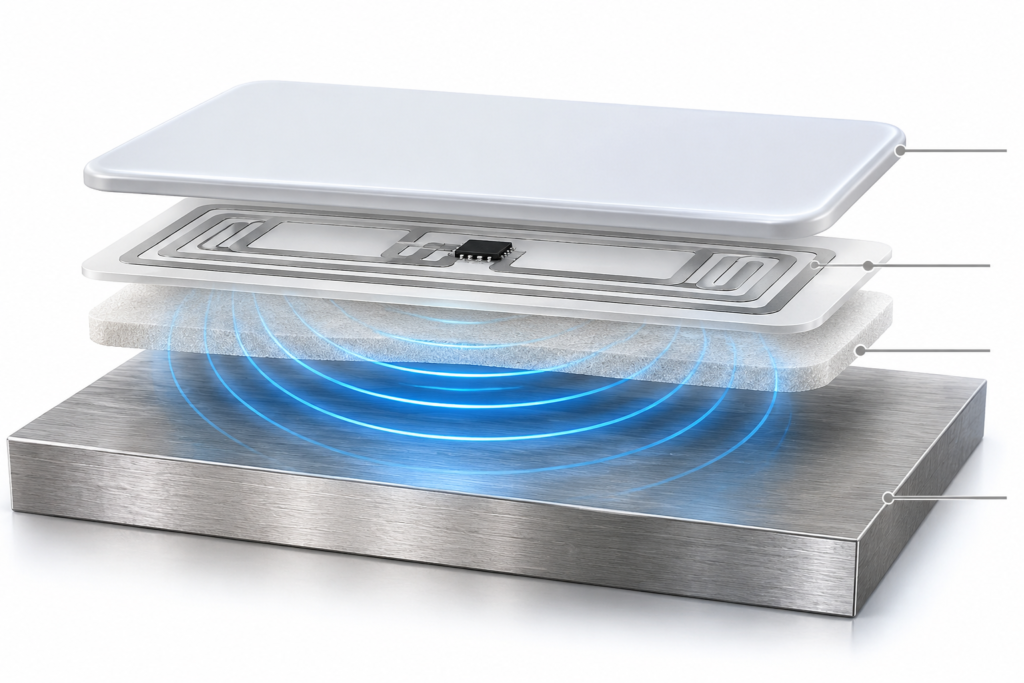
One approach is to introduce a dielectric spacer or isolation layer between the antenna structure and the metal surface.
The layer changes the electromagnetic relationship between the antenna and the conductive material. It can help reduce the adverse effects associated with placing a conventional antenna directly against metal.
However, spacing alone does not guarantee good performance. The antenna must still be designed and matched for the intended construction.
3.2 Antenna structures designed for metal mounting
Another approach is to use an antenna architecture specifically designed to operate with a conductive surface nearby.
Some on-metal UHF tag designs use structures such as patch antennas or planar inverted-F antennas (PIFAs). In these designs, the conductive surface may function as part of the intended electromagnetic structure, rather than simply acting as an unwanted nearby object.
The antenna geometry, substrate and matching network are designed together to achieve the required operating characteristics.
3.3 A dedicated backing or ground-plane structure
Some anti-metal designs incorporate a conductive backing or ground-plane arrangement.
This helps control the electromagnetic fields around the antenna and reduces its dependence on the material directly behind the tag.
The specific implementation varies between products. Not every anti-metal tag uses the same internal structure, and the presence of a backing layer alone should not be treated as proof of performance.
An important distinction: An anti-metal tag is not simply an ordinary RFID label with extra material added to its back. Its antenna and overall construction must be designed for the intended mounting conditions.
4. Common Types of Anti-Metal RFID Tags
Anti-metal RFID tags are available in different constructions. Three common product forms used in industrial applications are PCB-based, ABS-enclosed and flexible designs.
They address different mechanical and installation requirements. None is automatically the best choice for every application.
4.1 PCB Anti-Metal RFID Tags
PCB-based anti-metal tags use a rigid printed circuit board as part of the tag construction.
The antenna and associated components are integrated into a compact rigid structure. Depending on the design, the PCB and its backing arrangement help establish the required electromagnetic behavior when mounted on metal.
Typical application considerations:
- Industrial equipment identification.
- Metal tools and machinery.
- Fixed asset tracking.
- Applications requiring a rigid tag construction.
Potential trade-off: A rigid PCB structure may be unsuitable when the mounting surface is curved or when the installation space requires a highly flexible tag.
4.2 ABS Anti-Metal RFID Tags
ABS anti-metal tags generally use a rigid plastic enclosure to protect the internal RFID structure.
The enclosure, internal spacing and antenna design work together to support operation on the intended metal surface.
Typical application considerations:
- Metal containers and equipment.
- Industrial storage assets.
- Returnable transport items.
- Applications requiring a protective outer housing.
Potential trade-off: The rigid housing may require more installation space than a thin label-style design.
4.3 Flexible Anti-Metal RFID Tags
Flexible anti-metal tags are designed for applications where a rigid enclosure is inconvenient or where the tag needs to conform more closely to the mounting surface.
Their construction may combine flexible materials with an antenna structure designed for metal mounting.
Typical application considerations:
- Assets with limited mounting space.
- Certain curved or irregular surfaces.
- Applications where a low-profile tag is preferred.
- Industrial identification requiring a more conformable construction.
Potential trade-off: Flexibility does not automatically mean that a tag can withstand repeated bending, abrasion, chemicals or extreme temperatures. These requirements must be verified for the actual product.
4.4 Comparing the Three Designs
| Selection factor | PCB anti-metal tag | ABS anti-metal tag | Flexible anti-metal tag |
|---|---|---|---|
| Basic construction | Rigid PCB-based | Rigid plastic enclosure | Flexible construction |
| Mechanical form | Rigid | Rigid | More conformable |
| Installation space | Depends on model | May require enclosure clearance | Often useful where profile or conformity matters |
| Typical consideration | Compact rigid integration | Protective housing | Flexible mounting requirements |
| Important validation | Dimensions and mounting | Housing and environmental requirements | Bending, adhesion and mechanical durability |
This is a general construction comparison, not a universal performance ranking. Actual dimensions, reading performance, operating temperature and environmental resistance must be checked against the specifications of the selected model.
5. What Factors Should You Consider When Selecting an Anti-Metal RFID Tag?
Choosing an anti-metal tag should begin with the application, not simply the product category.
A tag that performs well on a large, flat steel panel may not deliver the same results on a small curved tool or a metal component with limited mounting space.
The following factors deserve particular attention.
5.1 Metal type and surface geometry
Identify the material and shape of the object.
Important information includes:
- Steel, aluminum or another conductive material.
- Flat, curved or irregular surface.
- Surface dimensions.
- Whether the tag is mounted directly or recessed.
- Whether other metal structures are nearby.
The size and geometry of the mounting surface can influence the electromagnetic environment around the tag.
5.2 Available installation space
The available mounting area determines which tag formats are physically suitable.
A large tag may allow a different antenna design from a very small one. Reducing tag dimensions can introduce design trade-offs involving antenna efficiency, bandwidth and performance.
Before selecting a product, measure the available mounting area and confirm the permitted tag thickness and footprint.
5.3 Required reading distance
Reading distance should be evaluated as a system-level result.
It depends on more than the tag itself. Reader output power, reader antenna gain and polarization, tag orientation, operating frequency, mounting surface and surrounding environment all matter.
A tag’s advertised free-space reading distance should not be treated as a guaranteed result when the tag is mounted on metal.
For this reason, compare products under equivalent test conditions and, whenever possible, on the actual target asset.
5.4 Operating environment
Industrial applications can expose tags to conditions such as:
- Temperature changes.
- Moisture and water exposure.
- Dust and dirt.
- Oil and chemicals.
- Vibration and mechanical impact.
- Repeated handling or abrasion.
The tag enclosure and materials should match the expected environment.
Do not assume that every ABS or flexible tag has the same environmental resistance. Check the specific product’s confirmed ratings and test evidence.
5.5 Mounting method
The tag may be installed using adhesive, screws, rivets, cable ties or another mechanical arrangement.
The mounting method affects installation space, mechanical stability and long-term reliability.
For example, a tag designed for adhesive mounting may not be suitable for an application involving frequent impact or surface contamination unless the adhesive and surface preparation are appropriate.
6. How to Test an Anti-Metal RFID Tag Before Deployment
A tag should not be approved solely because it can be read during a brief demonstration.
The more useful question is whether it can be read reliably under the conditions of the intended application.
A practical evaluation should reproduce the real mounting and reading environment as closely as possible.
Step 1: Confirm the application requirements
Document the target object, metal type, mounting area, available space and operating environment.
Step 2: Install the sample on the actual metal surface
Test the tag on the intended asset whenever possible.
If the final object is not available, use a representative metal sample with similar material, dimensions and geometry. Record the difference.
Step 3: Use a consistent reader setup
Record:
- Reader model.
- Reader antenna model.
- Operating frequency and regional configuration.
- Reader power setting.
- Antenna polarization.
- Reader-to-tag distance.
- Tag orientation.
The reader should operate within the applicable regional radio regulations.
Step 4: Test multiple positions and orientations
A tag may respond differently when its orientation changes relative to the reader antenna.
Test the positions and angles expected in actual operation rather than relying on a single favorable reading position.
Step 5: Evaluate repeatability
Repeat the test under the same conditions.
Where possible, record:
- Whether the tag is consistently identified.
- Read performance at different distances.
- Performance at different orientations.
- Any localized reading gaps.
- Changes caused by nearby metal structures.
Step 6: Validate the complete application
Finally, test the tag as part of the intended workflow.
For example, a tag mounted on a tool may need to be read while stored in a metal cabinet. A tag on a container may need to be identified while other containers are nearby.
Laboratory results are useful, but they do not replace validation in the actual deployment environment.
7. Common Mistakes When Selecting Anti-Metal RFID Tags
| Common mistake | Why it creates problems | Better approach |
|---|---|---|
| Choosing a tag based only on free-space reading distance | The mounting surface changes antenna behavior | Test on the intended metal object |
| Assuming all anti-metal tags are interchangeable | Different constructions have different design characteristics | Compare the actual product structure and specifications |
| Ignoring tag orientation | RFID antenna response can be direction-sensitive | Test realistic tag and reader orientations |
| Selecting a tag before measuring the mounting area | The product may not fit the asset | Confirm dimensions and installation clearance |
| Assuming every rigid tag is highly durable | Enclosure material alone does not establish environmental performance | Verify product-specific ratings and test results |
| Increasing reader power without investigating the cause | Higher power may introduce unwanted reads and interference | Evaluate the complete RF setup |
| Skipping sample validation | A suitable-looking product may fail in the real workflow | Test representative samples before approval |
One additional point is worth remembering: an on-metal tag is generally optimized for its intended metal mounting condition. It should not automatically be assumed to perform equally well when mounted on plastic or another non-metallic material. The RAIN RFID Alliance specifically recommends selecting on-metal tags for metal surfaces and considering their directional behavior during system design.
8. How HIVERFID Can Support Anti-Metal RFID Tag Selection
Selecting an anti-metal RFID tag requires more than matching a product name to an application.
The tag structure, antenna design, mounting surface, available space and operating environment all need to be considered together.
HIVERFID offers anti-metal UHF RFID tag options, including PCB, ABS and flexible constructions, for different industrial identification and asset-tracking requirements.
For customized applications, the selection process should begin with the customer’s actual installation conditions. Relevant information includes the metal surface, tag dimensions, mounting method, required reading performance and operating environment.
Where the available specifications are insufficient to make a reliable recommendation, sample evaluation on the intended asset is an important next step.
9. Conclusion: Select the Tag for the Surface, Not Just the Application
Ordinary UHF RFID labels can lose performance when attached directly to metal because the conductive surface changes the electromagnetic conditions around the tag antenna.
Anti-metal RFID technology addresses this challenge through antenna structures and tag constructions designed for metal-mounted operation.
However, PCB, ABS and flexible anti-metal tags are not interchangeable. The right choice depends on the asset geometry, installation space, environmental conditions, mounting method and required reading performance.
For industrial applications, the most reliable approach is to define the installation requirements first and validate the selected tag on a representative metal surface before deployment.
Need help selecting an anti-metal UHF RFID tag?
Share your metal surface type, available installation space, preferred tag construction, operating environment and required reading performance with HIVE RFID. Our team can help you evaluate a suitable product option for your application.
Frequently Asked Questions
1. Can a normal UHF RFID label work on a metal surface?
A conventional UHF RFID label may experience severe performance degradation when attached directly to metal. The conductive surface can change the antenna’s impedance and radiation characteristics. A tag specifically designed for metal mounting is generally the more appropriate choice.
2. What is the difference between an ordinary RFID tag and an anti-metal RFID tag?
An ordinary RFID tag is generally designed for a specified operating environment and may not function reliably when mounted directly on metal. An anti-metal RFID tag uses an antenna structure and construction designed to operate in the presence of a conductive surface.
3. Are PCB, ABS and flexible anti-metal RFID tags the same?
No. They have different mechanical constructions and installation characteristics. PCB designs are rigid, ABS tags generally use a protective plastic enclosure, and flexible tags are intended for applications where a more conformable structure is preferred. Their actual performance must be evaluated by model.
4. Do anti-metal RFID tags always provide a long reading distance?
No. Reading distance depends on the tag, reader, antenna, operating frequency, orientation, mounting surface and surrounding environment. Product specifications and application test conditions should always be considered together.
5. Can an anti-metal RFID tag be installed on plastic?
Some anti-metal tags may still be readable on non-metallic surfaces, but their design is optimized for a particular mounting condition. Performance on plastic should be verified rather than assumed.
6. What information should I provide when requesting an anti-metal RFID tag?
Provide the metal type, surface dimensions, available installation space, preferred tag form, mounting method, operating environment, reader information if available, required reading performance and estimated quantity. If some technical details are unknown, describing the application is a useful starting point.


